Thursday, 26 March 2015

Week 3, Reflection 2


This week we were asked to look at different ICTs for classrooms. I chose to make a weebly. I found making a weebly not as easy as making a blog. You have to drag text boxes where you want them whereas a blog is simple and structured. There weren't many templates that appealed to me and there wasn't much leeway design wise. In my weebly, I talk about blog features. Here is the link for you to check it out:


This is my PMI for weeblys:
Positive
Minus
Interesting
Different ICTs
No space for creativity, design wise
Very similar to blogs
Fairly easy to create
Not as safe as other websites


I just made a new Voki. See it here:

Using blogs and weeblys in classrooms would be beneficial to post more information about that days topics and any extra links that can be useful for more information. Specifically in a music classroom, a weebly could be created as an assignment about different musicians. They can have various pages relating to different topics such as 'songs they composed', 'life timelines' 'songs they are famous for'. I think that would be a very interesting way to display that information.

Wednesday, 18 March 2015

Week 2, Reflection 1

I am going to attempt to write this blog while my kitten hovers over me... (see I'm not joking)


Firstly I am going to talk about de Bono's Thinking Hats, then move on to 'What is Pedagogy' and then onto Bloom's Taxonomy and the SAMR model.


The Six Thinking Hats® Tool Kit


Blue Hat Thinking- Process
  • Thinking about thinking
  • What thinking is needed?
  • Organizing the thinking
  • Planning for action

White Hat Thinking- Facts
  • Information and data
  • Neutral and objective
  • What do I know?
  • What do I need to find out?
  • How will I get the information I need?

Green Hat Thinking - Creativity
  • Ideas, alternative, possibilities
  • Provocation - "PO"
  • Solutions to black hat problems

Yellow Hat Thinking- Benefits
  • Positives, plus points
  • Logical reasons are given.
  • Why an idea is useful

Black Hat Thinking - Cautions
  • Difficulties, weaknesses, dangers
  • Logical reasons are given.
  • Spotting the risks

Red Hat Thinking - Feelings
  • Intuition, hunches, gut instinct
  • My feelings right now.
  • Feelings can change.
  • No reasons are given.

(http://www.debonoforschools.com/asp/six_hats.asp)


Beginning this activity, my view on mobile phones was a definitive 'no way". However going through the scaffolding questions through the hats I found myself questioning my beliefs. Before completing the activity i read through other people's ideas on the topic. This gave me more of an insight into other ways of thinking which in turn made me think about the topic from different perspectives. Some issues i find with having personal mobile phones in class include, monitoring students access to make sure they are looking at the right things and internet safety.


    The learning theories I have linked with this topic is 'Social Constructivism' and 'Connectivism'. The wiki activity was based off of Social Constructivism as it was a collaboration of ideas and Connectivism in that it is using technology to participate in the activity.


    What is Pedagogy?

    Every teacher teaches differently. There isn't necessarily a 'good' or 'bad' pedagogy method. A 'good' method is one that achieves the desired learning outcome. Students all learn differently and what may be considered a good method for some students might not be a good method for other students. It is up to the teacher to discover what methods are best for each student and find a happy medium. 


    Bloom's Taxonomy and SAMR


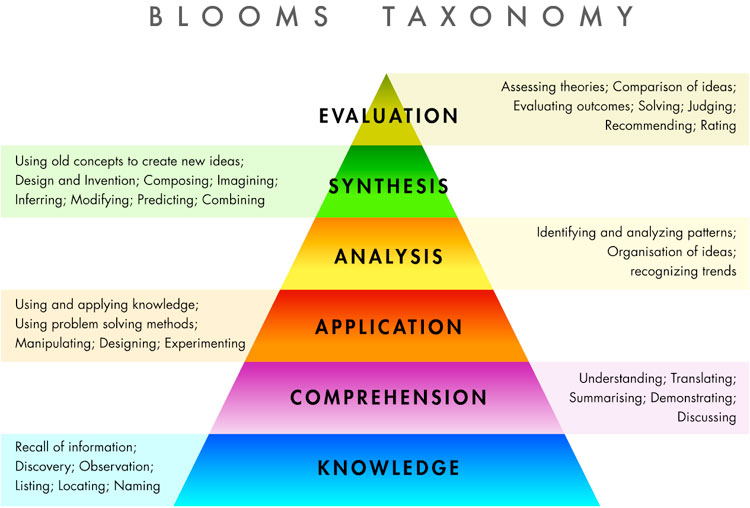
    (https://juliaec.files.wordpress.com/2011/04/blooms_taxonomy.jpg)


    Bloom's Taxonomy was created in 1956 to promote higher order thinking. Through activities the students are able to apply new knowledge to not just remember the facts (rote learning) but actually understand the concepts at a higher understanding. The process includes introducing student held knowledge, analysing this knowledge, deriving and strengthening knowledge and theory from this analysis, and then moving towards evaluation of the knowledge therefore creating culmination of learning.

    SAMR is A Model for Enhancing Instructional Technology Integration.

    SAMR
    Image the creation of Dr. Ruben Puentedura, Ph.D. http://www.hippasus.com/rrpweblog/
    (http://www.schrockguide.net/samr.html)

    The SAMR model is similar in design to Bloom's Taxonomy as the re-designed taxonomy is technologically based and helps students enhance their ICT skills and transform their knowledge into a deeper understanding and the SAMR model does the same. The enhancement helps students with the ICT skills and the transformation side helps students gain a deeper understanding of content through technology. 


    References:
    Candace M (2013) SAMR in 20 Seconds, retrieved from: https://www.youtube.com/watch?v=us0w823KY0g
    Donald Clark (1999-2015) Bloom's Taxonomy on Learning Domains, retrieved from: http://www.nwlink.com/~donclark/hrd/bloom.html#cognitive
    Google Images: https://juliaec.files.wordpress.com/2011/04/blooms_taxonomy.jpg
    Kathy Schrock (2013-2015) Kathy Schrocks Guide To Everything, retrieved from http://www.schrockguide.net/samr.html 

    Thursday, 12 March 2015

    Week 1

    Hi Everyone,

    My name is Erin Evans and I live in Rockhampton. Last year I completed my Bachelor of Music, Jazz and Popular, Specializing on Saxophone. Music has always been a big part of my life and throughout my senior schooling i realised that I wanted to teach music and encourage them to express themselves through music.


    Week 1

    Know Your Learner

    This week we watched a webinar by Judy Willis on "How the Brain Learns Best". To be honest I had no idea about the RAS, the Reticular Activating System. It filters out all the unnecessary stimulation that is not important to the immediate situation. To get the RAS to open and let important information filter through, the content must be interesting, stimulating and there must be no stress. While there is stress it cannot open. Thinking back to Res School, I think of Ragnar Purje's "I've got the power" lecture. Once students realise that they are responsible for their thinking and learning it is more likely that they will be more engaged in the class (permitting that it is still engaging). 

    Allowing a short SYN-NAPS to refocus the class would be a great thing to do or consider doing. This time can also be used to get feedback on how everyone is coping with the new information. A simple thumbs up, thumbs down can be an easy way to find out how they are doing. As the teacher, you should already have an understanding of how some of the students learn and whether they would be able to understand fully what was taught or whether they are the students that need more information to grasp the concept or if they need to go away and look over it by themselves.

    I think that using ICTs in classrooms can help to decrease stress as they can take things at their own pace. Such as videos, interactive powerpoints or group web activities. Online learning will allow students to repeatedly go over topics until they are confident with the subject. This is an advantage in relation to traditional classroom methods as they only get to go over the topic once in the classroom situation. Using interactive ICTs tools will make the student's learning more engaging.

    Learning Theory


    Behaviourism -This reminds me of my music studies... Practice, Practice, Practice. This repetitive lear
    ning theory I can agree with using in music classes with things like how to hold instruments and how to sit while holding instruments. With positive reinforcements when technique is correct, over time these techniques will become ingrained in the muscle memory.


    Cognitivism - If the information is not applied immediately, the information is lost. Having activities that can immediately apply the information will be the best way to make sure the information is absorbed and not discarded. 


    Social Constructivism - "learning is scaffolded by more knowledgeable others". This theory is a collaboration of ideas, with the students being "supported" by the teacher. They are to use the scaffolding given to them by the teacher to then learn and gradually climb their way up to their new found knowledge.

    Connectivism - The use of technology to further research topics, to link real life situations with in class curriculum to get a better understanding of the subject. The use if ICTs in classrooms will make this easy for students to research outside of class resources.

    As I look at all of the Learning theories, I can see that they all have their strengths and weaknesses however I don't think that there is one definitive Learning Theory as I believe that a mixture of each theory would be more beneficial for learning.